
Games
SimCity: Cities of Tomorrow Review
Review Ratings
Final Review Score
Great
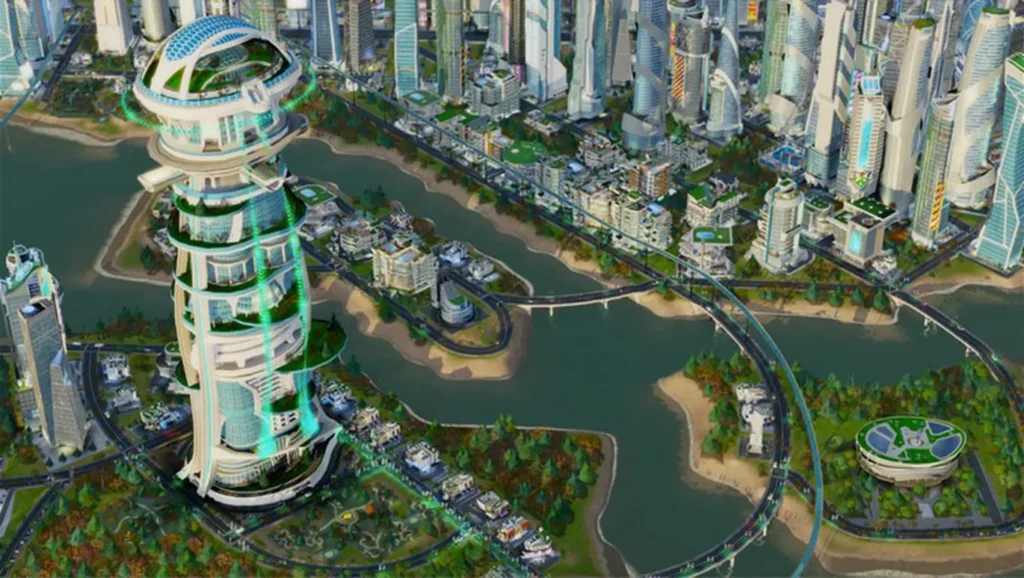
Developed by Maxis and published by Electronic Arts, SimCity: Cities of Tomorrow (2013) served as the ambitious sci-fi expansion pack for the 2013 SimCity reboot. Fast-forwarding fifty years into the future, the expansion directly tackled the base game’s spatial limitations by introducing vertical urban density, futuristic clean technologies, and corporate consumer empires. In this detailed SimCity: Cities of Tomorrow game review, we examine how soaring MegaTowers, rival ideological paths, automated drone networks, and futuristic infrastructure expanded the GlassBox engine.
Vertical MegaTowers, Dual Ideologies, and ControlNet
The defining feature of Cities of Tomorrow is the introduction of self-contained, sky-scraping MegaTowers that allow mayors to build upward rather than outward. Each multi-level module can be customized with residential levels, mall levels, office levels, waste reduction units, and skybridge connections, allowing Sims to live, work, and shop without ever touching the street below. Cities can align with two distinct futuristic philosophies: the eco-friendly, research-driven The Academy, which utilizes wireless ControlNet signals to power maglev trains, fusion reactors, and wave generators; or the ruthless mega-corporation OmegaCo, which manufactures addictive, lucrative commercial goods using heavy industrial pollution and delivery drones.
Maglev Transit, Dronenet Logistics, and Futuristic Hazards
To support high-density futuristic megalopolises, Maxis introduced high-speed elevated Maglev tracks that thread directly through MegaTower skybridges, bypassing street traffic entirely. Dronenet networks streamline police, fire, and health responses through automated aerial delivery, while garbage atomizers and sewage scrubbers resolve environmental pollution. The expansion also brought new futuristic threats, including giant corporate Outlaw robots and destructive eco-disasters that challenge even fully automated municipal defense systems.
GlassBox Visuals, Cyberpunk Aesthetics, and Dynamic Audio
Visually, Cities of Tomorrow transforms standard suburban plots into vibrant cyberpunk visual landscapes complete with glowing neon billboards, holographic projections, and sleek futuristic architecture. The visual contrast between clean, utopian Academy sectors and grime-covered, smog-filled OmegaCo zones creates stunning visual feedback. Composer Chris Tilton updated the dynamic orchestral score with synth wave textures, metallic percussion, and electronic harmonies that evolve alongside city specialization.
The Final Verdict
Ultimately, this SimCity: Cities of Tomorrow review evaluates a creative, visually striking, and inventive sci-fi expansion pack. Driven by Maxis’ vertical MegaTower mechanics, compelling Academy vs. OmegaCo ideological playstyles, and futuristic transit solutions, it stands as an engaging chapter in city-building history.
Information
- Title: SimCity: Cities of Tomorrow
- Release Date: November 12, 2013
- Developers: Maxis, Electronic Arts
- Platforms: PC (Windows), Mac OS X
- Genre: City-Building, Sci-Fi Simulation, Strategy
This post is part of SimCity Games Ranked