
Movies
A Nightmare on Elm Street Review
Review Ratings
Final Review Score
Decent
Directed by music video veteran Samuel Bayer from a screenplay by Wesley Strick and Eric Heisserer, A Nightmare on Elm Street (2010) sought to update Wes Craven’s 1984 classic with a darker, more somber tone for 21st-century audiences. Produced by Platinum Dunes, the reimagining strips away the theatrical one-liners of later sequels to focus on repressed childhood trauma, micro-naps, and a sinister, realistic burn-victim design. In this detailed A Nightmare on Elm Street (2010) movie review, we examine how slick modern visuals, psychological ambiguity, and a menacing lead performance breathed new life into Springwood’s dark history.
Micro-Naps, Forgotten Childhoods, and the Secrets of Badham Preschool
In the suburban town of Springwood, high school student Dean Russell suffers a horrific public death in a diner, witnessed by friend Kris Fowles (Katie Cassidy). Soon, Kris and her classmates—including reserved artist Nancy Holbrook (Rooney Mara), Quentin Smith (Kyle Gallner), and Jesse Braun (Thomas Dekker)—realize they are all sharing nightmares about a sinister man with a burned face and a razor-glove. As sleep deprivation causes terrifying “micro-naps” where reality bleeds seamlessly into dreamscapes, the teens uncover long-buried memories revealing they all attended Badham Preschool together as young children. Realizing their parents hunted down and burned school gardener Fred Krueger (Jackie Earle Haley) after allegations of abuse, Nancy and Quentin race to find the original preschool ruins to determine if Krueger was truly guilty before exhaustion forces them into his lethal domain.
Gritty Visual Atmosphere, Realistic Burn FX, and Steve Jablonsky’s Score
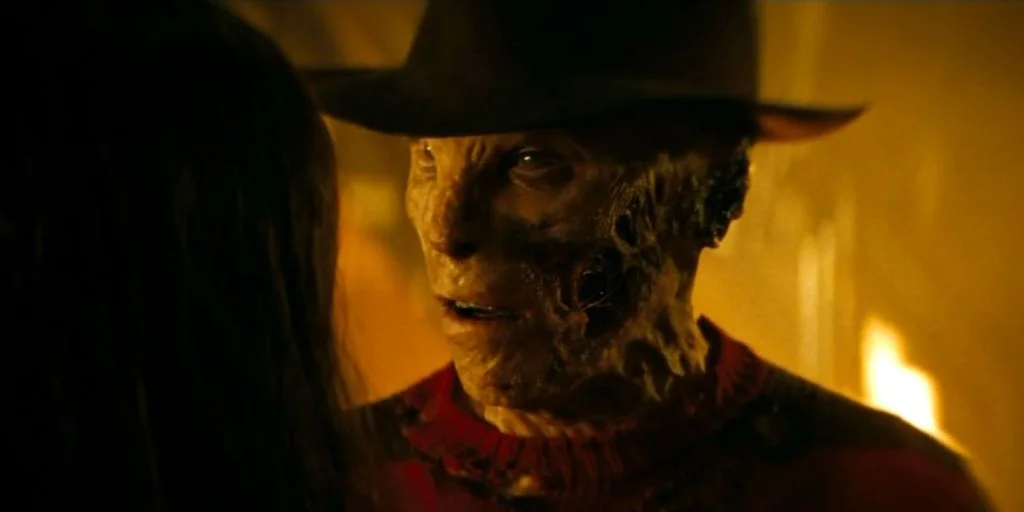
Director Samuel Bayer utilizes sharp cinematography, high-contrast digital lighting, and bleak colors to ground the nightmare sequences in oppressive atmospheric dread. The film shifts away from practical rubber prosthetics in favor of anatomically accurate burn makeup combined with subtle digital enhancements for Jackie Earle Haley’s face. Composer Steve Jablonsky provides a haunting orchestral score that incorporates Charles Bernstein’s classic synth nursery rhyme into heavy percussion, driving string swells, and dark metallic textures.
Jackie Earle Haley’s Terrifying Presence and Rooney Mara’s Dark Heroine
Oscar nominee Jackie Earle Haley delivers a dark, cold, and predatory performance as Fred Krueger, replacing the iconic camp showmanship of earlier sequels with menacing psychological malice. Rooney Mara brings a quiet, introspective, and brooding strength to Nancy Holbrook, showcasing the early talent that would launch her stellar career. Kyle Gallner turns in a strong supporting performance as Quentin, bringing desperation and intellectual resourcefulness to the fight against sleep.
The Final Verdict
Ultimately, this A Nightmare on Elm Street (2010) review evaluates a sleek, dark, and visually stylish modern slasher reimagining. Driven by Samuel Bayer’s atmospheric direction, Jackie Earle Haley’s sinister turn as Krueger, and strong lead performances, it stands as a memorable 2010s horror update.
Information
- Title: A Nightmare on Elm Street
- Release Date: April 30, 2010
- Director: Samuel Bayer
- Stars: Jackie Earle Haley, Rooney Mara, Kyle Gallner, Katie Cassidy, Thomas Dekker, Kellan Lutz, Clancy Brown
- Genre: Horror, Mystery, Thriller
This post is part of A Nightmare on Elm Street Movies Ranked