
Movies
Lightyear Review
Review Ratings
Final Review Score
Great
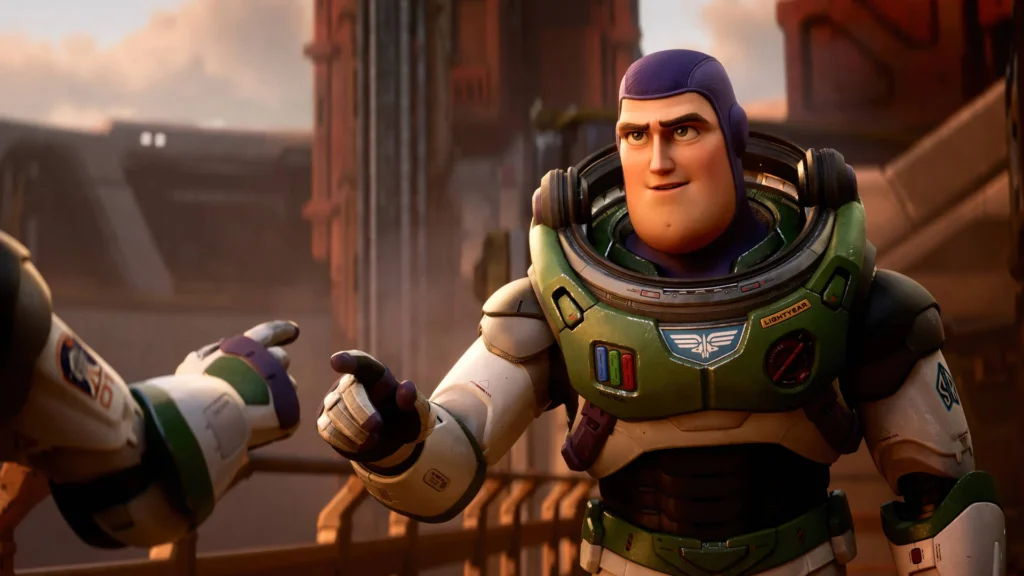
Directed by Angus MacLane (co-director of Finding Dory) and co-written with Jason Headley, Lightyear (2022) introduced an intriguing meta-concept to Pixar Animation Studios. Framed as the blockbuster 1990s sci-fi film Andy Davis saw in theaters that made him fall in love with the action figure, the movie separated the heroic ranger from his plastic roots to deliver a straight-faced space opera. In this detailed Lightyear movie review, we explore how Chris Evans, Keke Palmer, scene-stealing feline companion Sox, IMAX virtual camera pipelines, and Michael Giacchino’s heroic score launched a tactical sci-fi adventure.
Planet T’Kani Prime, Hyper-Speed Dilation, and the Junior Zap Patrol
The narrative begins when legendary Space Ranger Buzz Lightyear (voiced by Chris Evans) and his commanding officer Alisha Hawthorne (voiced by Uzo Aduba) land their exploration vessel on the hostile, vine-infested planet T’Kani Prime. When Buzz accidentally damages their ship’s crystal fuel cell during a hasty retreat, he strands the entire crew of scientists and rangers. Consumed by guilt and obsessed with finishing the mission, Buzz volunteers for test flights to calibrate hyperspace fuel. However, each test flight subject Buzz to time dilation: a four-minute flight for him equates to four years passing on T’Kani Prime. As decades pass in a flash, Alisha grows old and passes away while Buzz remains young. Returning from his final test flight, Buzz discovers the colony under siege by an army of robotic sentinels led by the mysterious, colossal Emperor Zurg, forcing Buzz to ally with Alisha’s grand-daughter, Izzy Hawthorne (voiced by Keke Palmer), her ragtag Junior Zap Patrol, and his emotional support robot cat Sox (voiced by Peter Sohn).
Chris Evans’ Commanding Voice, Sox the Robot Cat, and Team Dynamic
Stepping into the boots previously voiced by Tim Allen, Chris Evans strikes an impressive balance between stoic heroics and endearing stubbornness, perfectly capturing Buzz’s flaw of refusing to ask for help. The film’s absolute standout, however, is Peter Sohn as Sox, whose monotone delivery, hilariously functional gadgetry (from white noise emitters to blowdarts), and deadpan comedy stole every scene. Keke Palmer brings energetic optimism to Izzy, complementing Taika Waititi’s nervous recruit Mo Morrison and Dale Soules’ explosives-obsessed ex-con Darby Steel. The narrative shifts Buzz away from lone-wolf heroism, teaching him the value of trusting a team over personal perfection.
Chunky 1980s Sci-Fi Aesthetics, IMAX Animation, and Michael Giacchino’s Score
Visually, Lightyear stands as one of Pixar’s most visually ambitious technical achievements. Taking design cues from 1970s and ’80s sci-fi staples like Star Wars and Alien, the production designers created a “tactile, chunky” universe populated by heavy buttons, worn spacesuits, and industrial machinery models. It was also Pixar’s first film created with a native virtual IMAX aspect ratio pipeline, opening up vast space vistas and high-G flight sequences. Composer Michael Giacchino delivered a majestic, brass-heavy orchestral score anchored by soaring brass fanfare and emotional string arrangements during the time-dilation sequences.
The Final Verdict
Ultimately, this Lightyear review celebrates a gorgeously rendered, action-packed, and entertaining sci-fi entry in Pixar’s catalog. Driven by Angus MacLane’s passionate direction, Chris Evans’ strong lead performance, unforgettable comedic support from Sox, and IMAX-scale visuals, it delivers a thrilling ride to infinity and beyond.
Information
- Title: Lightyear
- Release Date: June 17, 2022
- Director: Angus MacLane
- Key Cast: Chris Evans, Keke Palmer, Peter Sohn, Taika Waititi, Dale Soules, Uzo Aduba, James Brolin, Mary McDonald-Lewis
- Genre: Animation, Sci-Fi, Action, Adventure, Family
This post is part of Pixar Movies Ranked