
Movies
The Matrix Revolutions Review
Review Ratings
Final Review Score
Amazing
Released in November 2003, mere months after The Matrix Reloaded, The Matrix Revolutions brought The Wachowskis‘ landmark sci-fi trilogy to a dramatic, action-heavy conclusion. Resolving the massive cliffhangers left in its predecessor, this final chapter shifts focus toward an all-out apocalyptic war for human survival alongside an intimate spiritual journey into the heart of the Machine City. In this detailed The Matrix Revolutions movie review, we examine how mechanical combat set pieces, emotional character arcs, and a fateful duel between Neo and Agent Smith conclude an era of cyberpunk cinema.
The Siege of Zion and the Journey to Machine City
Picking up immediately after the previous installment, Neo (Keanu Reeves) remains trapped in a limbo station between the Matrix and the physical machine world. After Trinity (Carrie-Anne Moss) and Morpheus (Laurence Fishburne) rescue him, humanity faces imminent annihilation as hundreds of thousands of Sentinels drill directly into Zion. While Captain Niobe (Jada Pinkett Smith) and the human defenders pilot Armored Personnel Units (APUs) in a desperate last stand inside the Dock, Neo and Trinity pilot the Logos directly toward the glowing heart of the Machine City. Recognizing that a rogue Agent Smith (Hugo Weaving) threatens both humans and machines alike, Neo bargains for peace in exchange for eradicating the virus-like entity.
Industrial War Choreography, Groundbreaking CGI, and Operatic Score
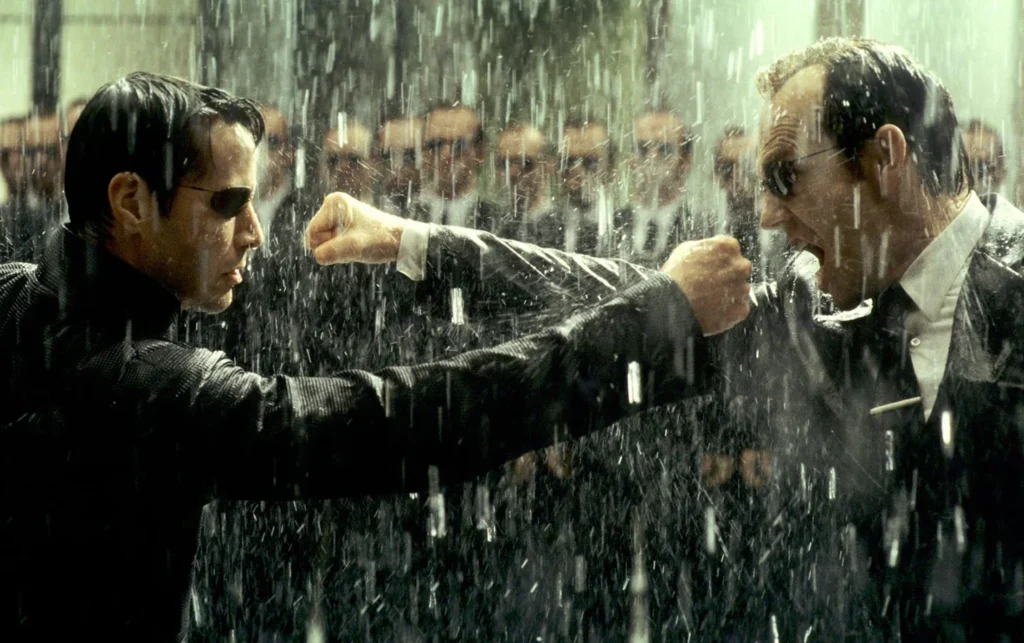
The Wachowskis trade martial arts duels for sweeping industrial warfare during the central Siege of Zion. The visual effects team delivers immense scale, showcasing thousands of metallic Sentinels swarming human exoskeletons in rain-drenched subterranean bays. The climactic showdown between Neo and Agent Smith takes place in a torrential downpour inside a corrupted Matrix, framed like an apocalyptic superhero clash. Composer Don Davis crafts his most ambitious, operatic score of the series, incorporating heavy choral arrangements and brass dynamics that heighten the tragic weight of the final act.
Resonant Performances and the Resolution of Choice
Keanu Reeves delivers a mature, selfless performance as Neo, fully embracing his destiny not as a mere weapon, but as a peacemaker. Carrie-Anne Moss provides deep emotional resonance as Trinity, sharing powerful final moments with Neo that anchor the film’s personal stakes. Laurence Fishburne brings regal dignity to Morpheus as his faith is finally vindicated, while Hugo Weaving radiates unhinged megalomania as the omnipresent Agent Smith. The narrative resolves the overarching theme of choice versus fate, offering a peaceful resolution rather than simple destruction.
The Final Verdict
Ultimately, this The Matrix Revolutions review highlights a visually spectacular, emotionally satisfying culmination to a groundbreaking trilogy. Guided by The Wachowskis’ ambitious vision, colossal action set pieces, and a memorable final confrontation, it delivers an epic, thought-provoking farewell to one of cinema’s most iconic sci-fi universes.
Information
- Title: The Matrix Revolutions
- Release Date: November 5, 2003
- Director: The Wachowskis
- Stars: Keanu Reeves, Laurence Fishburne, Carrie-Anne Moss, Hugo Weaving, Jada Pinkett Smith, Mary Alice
- Genre: Sci-Fi, Adventure, Action
This post is part of The Matrix Movies Ranked