
Movies
Indiana Jones and the Temple of Doom Review
Review Ratings
Final Review Score
Amazing
Directed by Steven Spielberg from a story by George Lucas, Indiana Jones and the Temple of Doom (1984) delivered a darker, faster, and more intense follow-up to Raiders of the Lost Ark. Functioning as a prequel set in 1935, the film took a daring stylistic turn away from biblical artifacts and Nazi villains to craft an intense pulp-adventure nightmare. In this detailed Indiana Jones and the Temple of Doom movie review, we explore how relentless stunt set pieces, iconic companion dynamics, underground cult mythology, and groundbreaking visual effects influenced blockbusters and helped establish the PG-13 rating.
The Club Obi-Wan Flight, Sankara Stones, and Pankot Palace
Opening with a sparkling Shanghai nightclub confrontation over a diamond, archaeologist Indiana Jones (Harrison Ford), nightclub singer Willie Scott (Kate Capshaw), and young sidekick Short Round (Ke Huy Quan) narrowly escape assassination aboard a cargo plane. Stranded in rural Northern India, the trio arrives at Mayapore, a desolate village whose sacred Sankara Stone and children have been stolen. Investigating nearby Pankot Palace, Indy uncovers a sinister subterranean lair beneath the royal estate where high priest Mola Ram leads the revived Thuggee cult, sacrificing captives to the goddess Kali and forcing enslaved children to mine for remaining sacred stones.
Short Round Chemistry, High-Octane Stunts, and PG-13 Impact
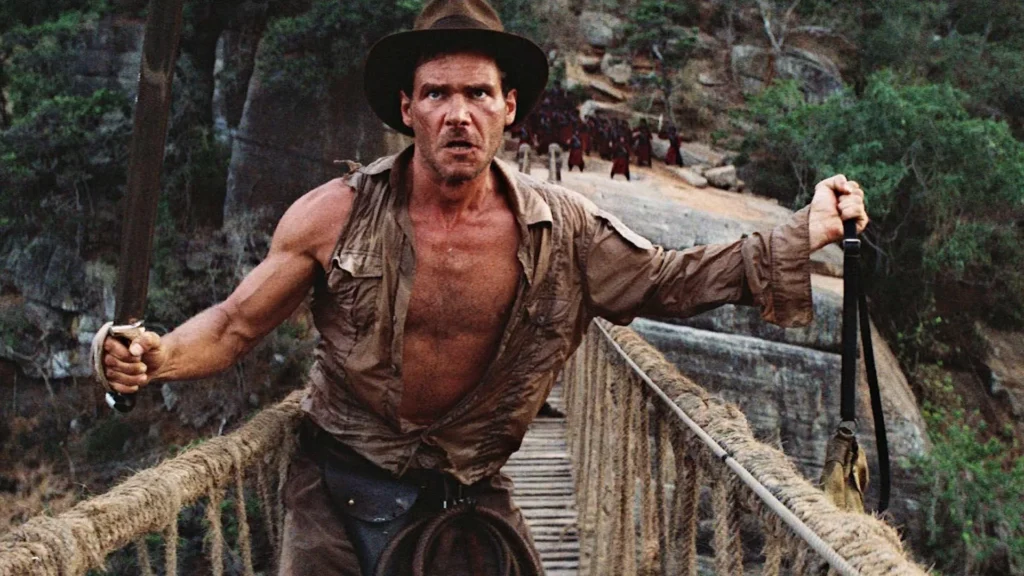
Harrison Ford brings exceptional physical commitment to Indy, enduring intense hand-to-hand combat while battling the hypnotic Black Blood of Kali. Ke Huy Quan delivers a breakout performance as Short Round, forging a endearing father-son bond with Indy that gives the dark narrative genuine heart. The film plays like an unrelenting roller-coaster ride, famous for landmark action sequences: the spike-chamber escape, the infamous stomach-churning banquet, a heart-pounding underground mine cart chase, and a dramatic rope bridge standoff over a crocodile-infested river.
Visual Darkness, Special Effects, and John Williams’ Score
Cinematographer Douglas Slocombe bathed Pankot’s underground catacombs in fiery crimson hues, matching Norman Reynolds’ towering set designs and ILM’s innovative miniature visual effects. Composer John Williams crafted a pulse-pounding score, blending fast-paced comedic chase fanfares with ominous choral chants for Mola Ram and an uplifting theme for the rescued village children.
The Final Verdict
Ultimately, this Indiana Jones and the Temple of Doom review celebrates a wildly ambitious, exhilarating, and visually daring entry in the franchise. Driven by Steven Spielberg’s relentless pacing, Harrison Ford and Ke Huy Quan’s dynamic partnership, and legendary practical set pieces, it remains an unforgettable action-adventure classic.
Information
- Title: Indiana Jones and the Temple of Doom
- Release Date: May 23, 1984
- Director: Steven Spielberg
- Key Cast: Harrison Ford, Kate Capshaw, Ke Huy Quan, Amrish Puri, Roshan Seth, Philip Stone
- Genre: Action, Adventure
This post is part of Indiana Jones Movies Ranked